The Myth of Balanced Play in Small-Stakes Cash Games
"Play balanced."
It's advice that sounds wise — almost sacred — in poker circles. Don't bluff too much. Don't value-bet too thin. Keep your ranges mixed so no one can read you. On paper, that sounds like the secret to long-term success.
But when you sit down in a small or mid-stakes cash game, that same principle can quietly limit your profit. The problem isn't that balance is wrong; it's that most players apply it in the wrong environment.
What "Balanced Play" Really Means
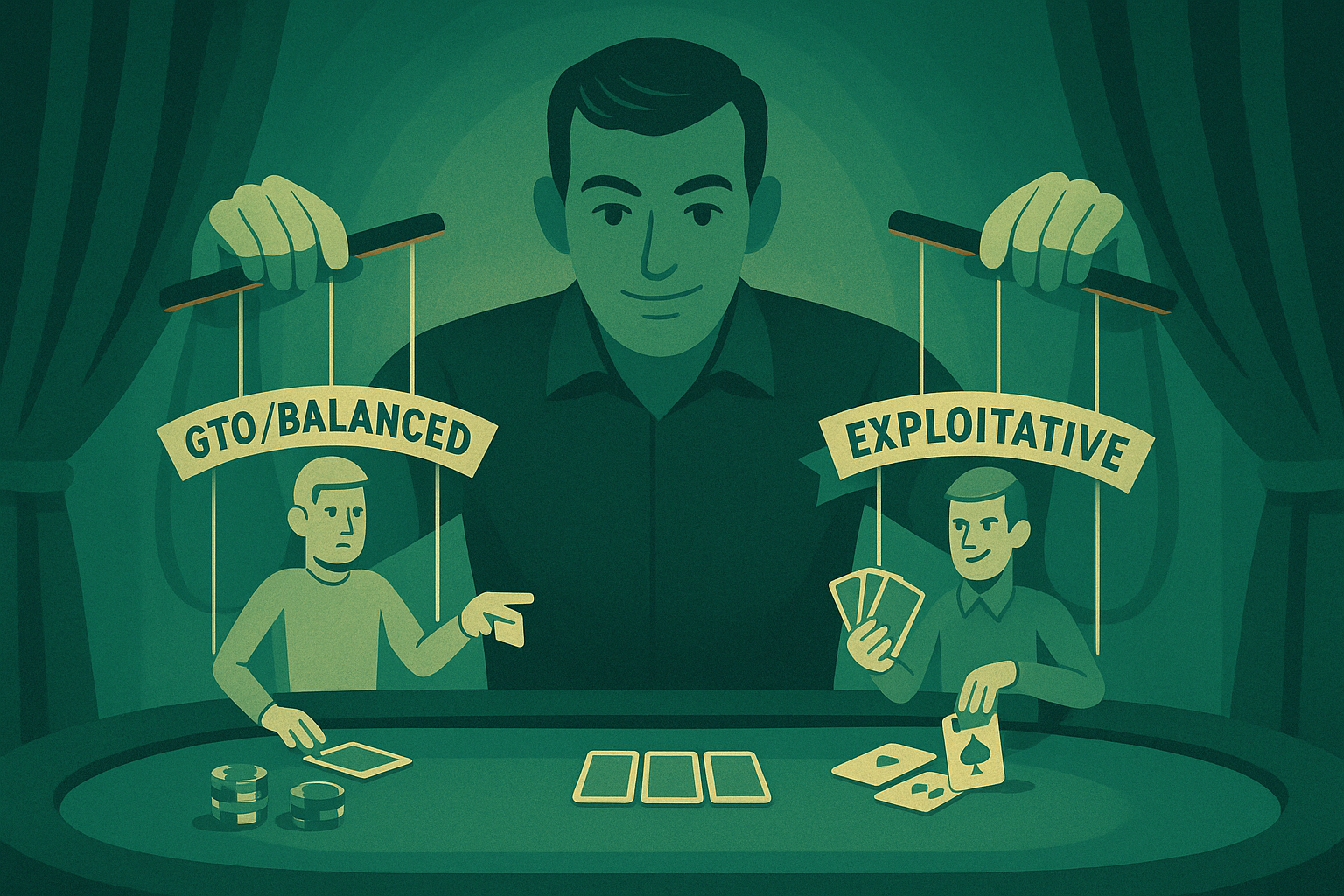
Balanced play comes from the idea of Game Theory Optimal (GTO) strategy — a theoretical framework where your decisions can't be exploited in the long run. You bluff at the right frequency, value-bet at the right frequency, and defend your hands just enough so opponents can't profit by adjusting against you.
In a world full of perfect players, balance would be the holy grail. But poker isn't played in that world. It's played against real people — people who fold too much, call too light, or never bluff at all. And when your opponents are unbalanced, your job isn't to be perfect. Your job is to exploit them.
Why Perfect Balance Can Be Imperfect Strategy
Let's imagine you're playing $1/$2 No-Limit Hold'em. You raise preflop, the big blind calls, and the flop comes K♠ 6♣ 2♦. You have A♠ K♣ — top pair, top kicker.
Now, a solver might tell you to bet this hand 70% of the time and check 30%, mixing in weaker hands and bluffs for protection. But if you know your opponent folds to a continuation bet two-thirds of the time, that 30% "checking range" is wasted potential. Why balance a range when your opponent won't even challenge it?
Balance is valuable when your opponent plays close to theory. But if they don't — and most small-stakes players don't — your balanced play turns into missed opportunities. You're trying to protect yourself from a threat that doesn't exist.
Exploitation Is Not Recklessness
Deviating from balance doesn't mean going wild. It means adjusting with purpose. It's about noticing patterns and responding to them.
If someone folds too much, you bluff more.
If someone never folds, you stop bluffing entirely.
If someone raises every time you check, you can set traps by checking strong hands.
You're no longer playing a static strategy; you're playing them.
Over time, these small deviations snowball into significant profit — because every hand becomes a data point in understanding your opponents' mistakes.
A Quick Example
Say you're facing a player who always folds to 3-bets unless they have a premium hand. A "balanced" player will still 3-bet with some bluffs, maintaining a mix. But an exploitative player stops bluffing altogether, saving those chips for value 3-bets only.
The result? Every time the opponent calls, you're miles ahead. Every time they fold, you win the dead money. No theoretical balance required.
When Balance Still Matters
Of course, balance isn't useless. Against tougher players — the ones who notice patterns and adjust — a baseline understanding of GTO keeps you from being predictable. Think of it as armor: you wear it when you need protection, but you don't go to the beach wearing a full suit of armor.
Balance gives structure; exploitation gives profit. The skill lies in knowing when to wear which.
The Practical Takeaway
Don't fear imbalance. If the game is full of players who can't exploit you, you don't need to protect yourself from them.
Review and refine. Look at your biggest pots after a session and ask, "Did I play this hand balanced… or profitable?"
Final Thoughts
Poker isn't a math test — it's an interaction between imperfect people. The solver doesn't know that the man in seat four folds every time he misses the flop, or that the woman in seat six calls rivers just to "see it." You do.
So don't chase theoretical perfection at tables full of human imperfection. Balance might keep you safe, but it won't make you rich.
In small and mid-stakes poker, the players who win big aren't the ones who play perfectly — they're the ones who notice who doesn't.
In our app Rivernuts, you can see exactly how the player pool actually deviates from solver play and learn how you should adjust your strategy against it. Stop guessing and start exploiting with real data.
Ready to Exploit Real Player Tendencies?
Learn when to play GTO and when to deviate for maximum profit. See how real players differ from solvers with our population data analysis.
Join Beta Now