Poker Math You'll Actually Use: A Friendly Walk Through the Numbers
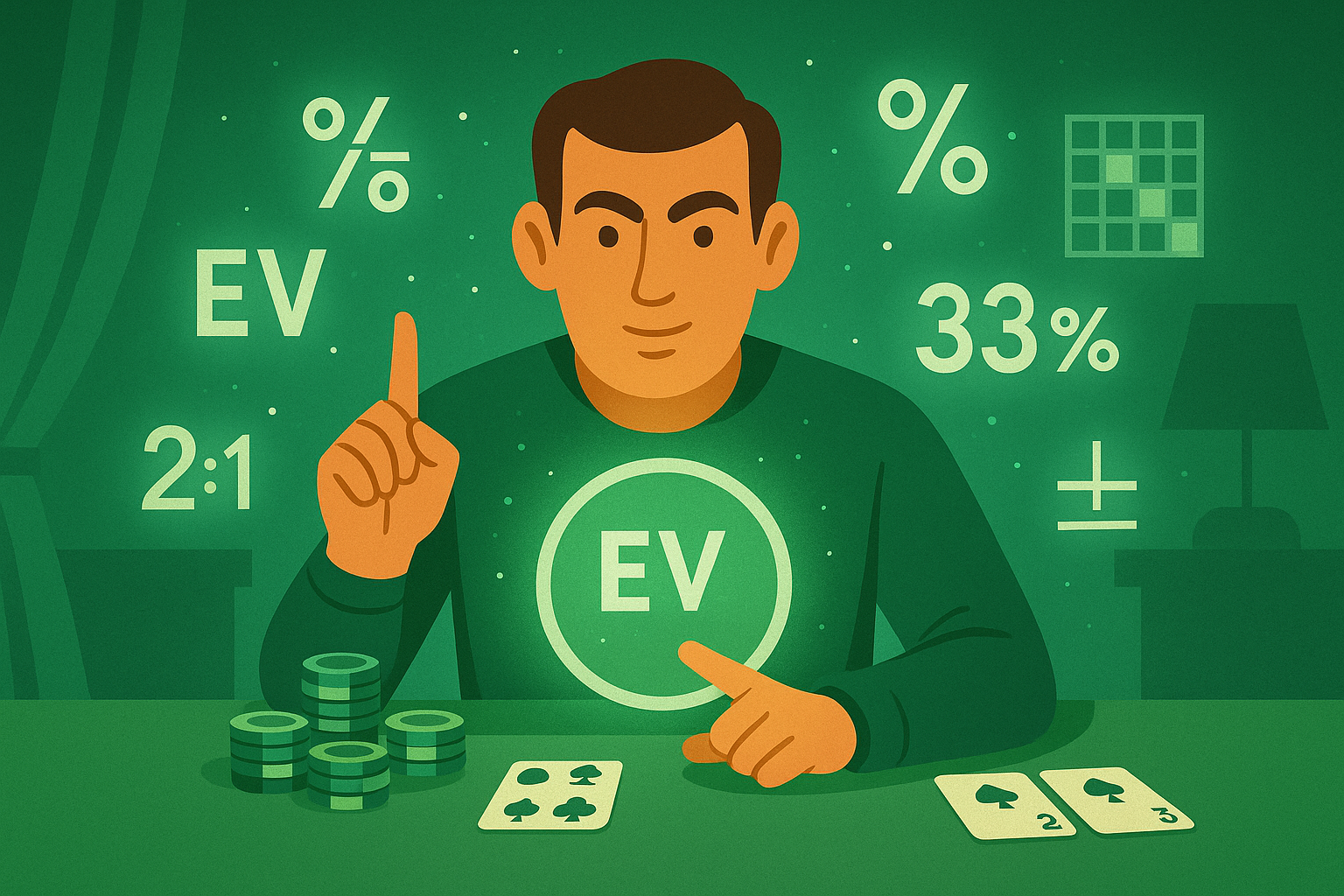
Poker math isn't a wall of formulas—it's a set of quick lenses you use to see a hand clearly. Think of this as a short walk through the ideas you'll lean on most at the tables, each with one grounded, real-number example that actually adds up.
Pot Odds: "What price am I getting?"
Pot odds tell you the equity you need to continue. If you must call $40 into a pot that's $60 and Villain bets $40, the total after you call is $60 + $40 + $40 = $140. Required equity = $40 / $140 ≈ 28.6%.
Example: You hold a flush draw on the flop that has about 36% equity (two cards to come). Since 36% > 28.6%, a call is profitable on direct odds alone.
Outs → Equity: "How often do I hit?"
Use the rule of 4 and 2. From the flop with two cards to come: equity ≈ outs × 4%; from the turn: outs × 2%.
Example: Open-ender (8 outs) on the flop ≈ 8 × 4% = 32%. That's a solid benchmark to compare against your pot odds.
Implied Odds (and Reverse Implied): "What happens after I hit (or when I'm second-best)?"
Direct odds sometimes say "fold," but future winnings can tip it. Suppose you call $20 facing $20 into $60 (total after calling $100). Your draw's equity is 16% (e.g., two overcards + backdoor). Directly, you're short of the 20% you need. Break-even extra money needed:
We want EV ≥ 0 ⇒ 0.16 × (100 + W) − 0.84 × 20 ≥ 0 ⇒ W ≥ 5.
Example: If you expect to win just $5 more on average when you improve, the call breaks even; more than that, it's +EV. Flip the lens for reverse implied odds: dominated top-pairs or weak flushes at deep SPR can cost you extra when you "improve" to the second-best hand—tighten up those calls.
Minimum Defense Frequency (MDF): "How often must I continue so they can't print?"
As the defender, MDF = Pot / (Pot + Bet). Facing half-pot into $100 (so bet $50): MDF = 100 / 150 = 66.7%.
Example: If this is a river spot where your range is indifferent, you should continue (call or raise) with roughly two-thirds of it; otherwise Villain's half-pot bluffs auto-profit.
Alpha (Required Folds for a Bluff): "What does my bluff need to work?"
For the bettor, the bluff break-even fold % is α = Bet / (Pot + Bet). If you bluff $33 into $100, α = 33 / 133 ≈ 24.8%.
Example: If you credibly get folds > 25%, your one-and-done bluff is profitable. On the river, that also sets a balanced bluff:value ratio near 1:3 for that sizing.
Fold Equity in EV Form: "Why pressure prints money"
EV of a pure bluff = Fold% × Pot − (1 − Fold%) × Bet.
Example: Pot $100, you bet $75. If they fold 50%, EV = 0.5×100 − 0.5×75 = +$12.50. If they only fold 40%, EV = 0.4×100 − 0.6×75 = −$5. The line is exactly at α = 75 / 175 ≈ 42.9% folds.
Equity Realization (EQR): "Not all equity cashes out equally"
Raw equity is step one; EQR says how much of it you actually realize. Position, board texture, and skill all nudge EQR.
Example: You have 35% raw equity. In position you might realize ~90% of it ⇒ effective 31.5%. Out of position against a tough c-bet, maybe ~60% ⇒ 21%. That gap alone can turn a marginal defend into a clear fold OOP.
SPR (Stack-to-Pot Ratio): "How big is the fight we're choosing?"
SPR = effective stack / pot at the start of the street. Low SPR favors one-pair value; high SPR rewards nutty, robust hands.
Example: Single-raised pot: flop pot $27, stacks $200 ⇒ SPR ≈ 7.4—top pair/top kicker is pot-controllable, not stack-off by default. 3-bet pot: flop pot $45, stacks $180 ⇒ SPR = 4—now TPTK can comfortably play for stacks on many boards.
Combinatorics & Blockers: "Count hands; choose bluffs that block value"
Starting combos: suited = 4, offsuit = 12, pairs = 6. Blockers remove villain's value combos and can improve your bluff EV.
Example (river, polarized line): Board K♠ 7♠ 2♦ 9♣ 4♠. If Villain repps strong flushes and you hold A♠Q♥, you block the nut-flush, reducing their value combos; you also don't block missed straight draws (their bluffs). That's a cleaner bluff candidate than, say, Q♠J♠, which blocks folds and over-blocks value.
River Call Thresholds: "How often must I be right?"
Your price to call sets your needed win rate. Facing a pot-size bet, you're getting 2:1, so you need to be right > 33%. Combo version: at pot bet, bluff:value at balance is 1:1.
Example: If you count 10 value combos, you need ≥ 10 bluff combos to justify a call. If you only find 6–7 bluffs credibly, it's a fold.
Rake: "The silent drag on close spots"
Rake raises your break-even thresholds, especially in small pots.
Example: $1/$2 with 10% rake, $5 cap, "no flop, no drop." Calling $10 pre to win $30 would need 25% equity in a rake-free world. If the table takes $3 once the flop is seen, the realizable pot shrinks and your real required equity climbs. Marginal blind defends and thin peels that were breakeven on paper become folds after rake.
Poker math won't play hands for you—it just keeps you honest. Use these checkpoints to anchor your instincts, and see the same hand through multiple lenses: price, future winnings, pressure, realization, depth, and combos. Want more bite-sized strategy like this? Come explore more at rivernuts.io.
Ready to Master Poker Math?
Learn to use pot odds, implied odds, and equity calculations to make better decisions at every street with our comprehensive training platform.
Join Beta Now