Evolving Your Post-Flop Betting Strategy: From Merged to Polar
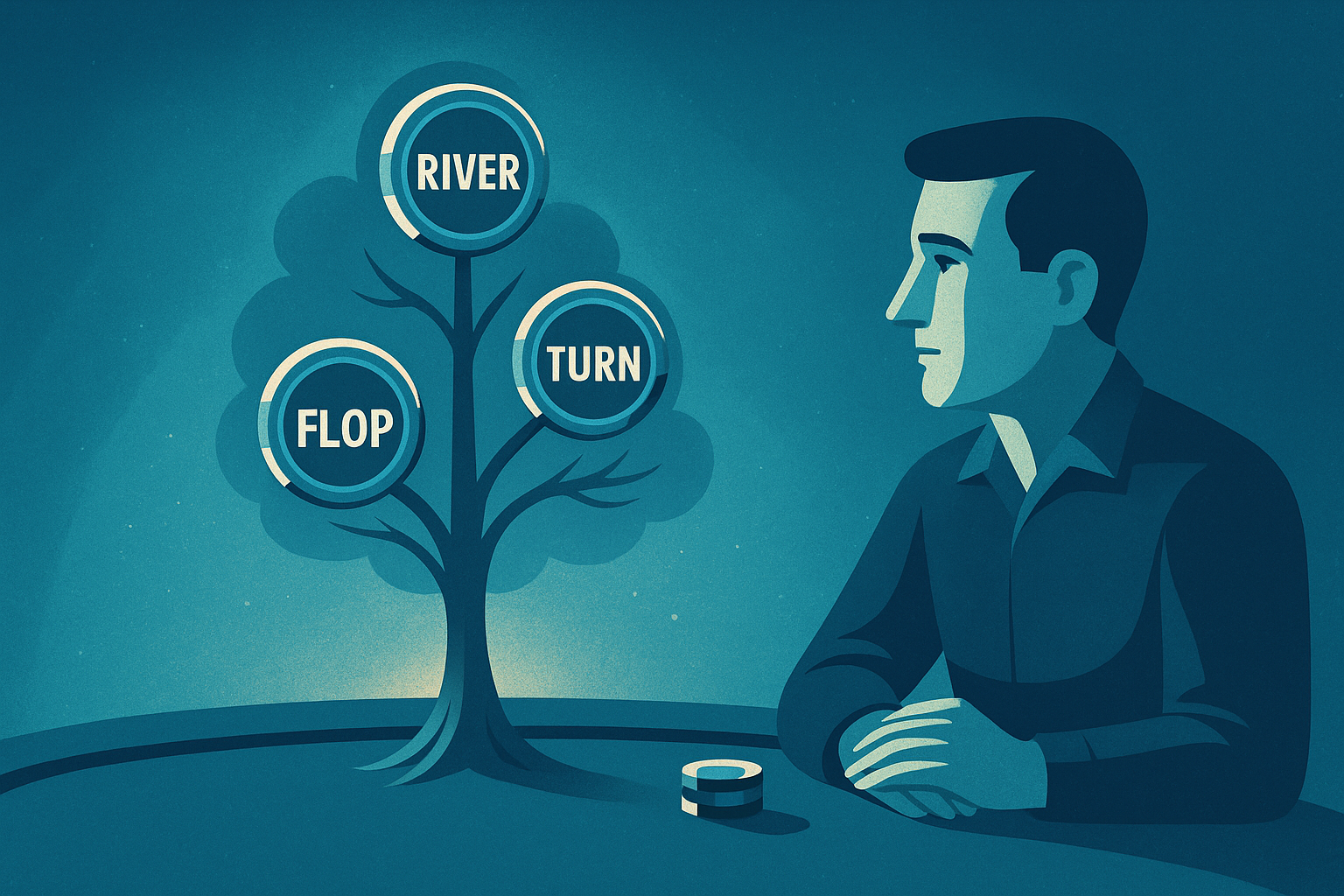
Once the flop hits, your job as a poker player shifts from "what do I have?" to "how do I represent my range?" Every decision — whether to bet, how much, and with which hands — builds the shape of your range across the streets. The deeper you go into a hand, the more that range evolves from merged (many types of hands, smaller bets) to polarized (only strong value and bluffs, larger bets).
Before diving in, let's clarify one crucial point. These are not hard rules. They apply mainly to situations where you're the betting aggressor — the player dictating the pace from flop to river. Poker is far more complex than a simple pattern.
Sometimes you defend a flop, your opponent slows down on the turn, and you arrive at the river with a condensed range — mostly medium-strength hands. In those cases, optimal sizing can flip entirely; you might use smaller block bets, even in position. Similarly, extreme board textures or passive lines require adjustments outside these heuristics.
What follows, then, are guiding principles — a framework for shaping your aggression when you're the one in control of the streets.
1. Betting Strategy Types: Merged vs. Polar
Post-flop betting ranges fall broadly into two advanced categories: merged and polar.
Merged ranges mix strong value, medium-strength hands, weaker value, and some bluffs or semi-bluffs. You're betting a wide slice of your holdings.
Polar ranges contain only your strongest value hands and your weakest bluff candidates. Medium-strength hands are mostly excluded; they do better checking or bluff-catching.
Some players — especially beginners — use what's called a linear range, where they simply bet their hands from strongest downward, rarely bluffing. These ranges are extremely predictable and exploitable. Once opponents notice, they'll fold when you bet and attack when you check.
Advanced play revolves around merged and polar strategies, and your degree of polarization shifts continuously with bet sizing and board texture.
2. Sizing and Range Shape
Your bet size dictates how polarized your range can be:
Small bets (around ⅓ – ½ pot) support merged ranges. You can bet more frequently with a broader mix of hands — top pair, second pair, strong draws, even some weaker ones. But mathematically, you can include fewer bluffs, since small bets don't need as many folds to show profit.
Medium bets (about ⅔ – ¾ pot) start trimming your range. You'll still include value, draws, and some bluffs, but you begin excluding hands that are too weak to bet often.
Large bets and overbets (full pot and beyond) demand polarization. Your range now consists mostly of top-end value hands and carefully chosen bluffs that benefit from fold equity or key blockers. Medium-strength hands disappear — they simply don't perform well in massive pots.
Think of it as a gradient:
- Small sizing → wider, more merged range
- Large sizing → narrower, more polarized range
3. Texture and Board Dynamics (Flop Context)
The texture of the flop — how connected, draw-heavy, or static it is — directly affects both your bet sizing and your range shape.
Dynamic Boards
Take K♥ T♥ 3♦. This texture is both draw-heavy and high-card rich, meaning you often hold both range advantage and nut advantage as the pre-flop raiser. There are strong top-pair combinations, two-pair possibilities, and plenty of draws that your opponent will struggle to defend.
Here, you can often use large bets or overbets. Why? Because your nutted hands want to extract maximum value while your opponent's draws face uncomfortable pot odds. Larger sizing forces mistakes — they either over-call weakly or fold too tightly — and it lets you balance those monsters with a few well-selected bluffs that block the best calling hands.
Static Boards
Now consider A♣ 8♦ 8♥. This is a dry, static board with very few draw possibilities. Equity shifts minimally on later streets. It's ideal for a smaller, merged bet — perhaps around ⅓ pot — since many of your hands (like A-Q, A-J, or even K-8 suited) can bet for value, and you can include a modest amount of bluffs. Big bets make less sense here; they'd isolate you against only the strongest portions of your opponent's range.
To dive deeper into how different textures influence solver recommendations, head over to RiverNuts.io Flop Reports, where you can filter by texture type and see which bet sizes solvers prefer for each class of board.
4. SPR and Stack Depth
Stack-to-Pot Ratio (SPR) determines how much maneuvering space you have across streets.
High SPR (deep stacks): more post-flop flexibility. You can bet smaller and keep your range merged longer because medium-strength hands still have room to realize equity.
Low SPR (shallow stacks): decisions are compressed; pots grow quickly. Medium hands lose playability. You move faster toward polarized strategies with larger bets and fewer thin value bets.
As stacks shorten or pots swell, the middle of your range naturally falls away, leaving only strong value and credible bluffs to continue betting.
5. Turn and River: The Shift Toward Polarization
Turn
Once the turn falls, uncertainty drops — only one card remains. Your range typically thins out. Fewer hands can improve, and medium-strength holdings often check or call rather than bet. That pushes your betting range toward polarization.
You might still use smaller bets occasionally (especially on dynamic turns that change equities), but in most cases, you begin betting larger — focusing on hands that can value-bet for stacks and bluffs that threaten those same stacks.
River
On the river, all equity is realized. At this point, betting with medium-strength hands rarely makes sense. You're either going for value or bluffing. Hence, river bets tend to be large or overbet, particularly when you retain nut advantage or your opponent's range is capped.
There are exceptions, though. If you reach the river out of position with a condensed range — mostly hands that called earlier but didn't raise — you may opt for small "block" bets to deny equity or set your own price for showdown. These situations break the heuristic pattern, reminding us that poker's complexity always resists rigid formulas.
6. Bluff Selection Through the Streets
Bluffing evolves with each street:
Flop and turn: prioritize semi-bluffs — hands with equity (flush draws, straight draws, overcards). They perform well as part of merged ranges.
River: equity is gone, so your bluffs must rely on blockers and fold equity. Choose hands that block your opponent's best calls — for instance, holding the ace of a suit on a completed flush board.
The deeper you go, the narrower your bluffing range becomes, but each chosen bluff should carry strong strategic justification.
7. Exploitative Layer
Theory provides structure; opponents provide opportunity. Population tendencies should always influence how you deviate.
- If your opponents under-bluff, value bet thinner and fold more to aggression.
- If they over-fold, widen your bluffing range and use larger sizes.
- If they call too wide on early streets, reduce bluff frequency and keep extracting with merged, smaller bets.
And remember: when the turn or river dramatically favors your range — say, completing a straight or flush you represent far more often — it's your cue to size up and push maximum fold pressure.
Conclusion
When you're the aggressor, the general rhythm of post-flop play follows a familiar arc: Start with small, merged bets on the flop; transition to larger, more polarized bets by the river. But always remain aware of context — condensed ranges, positional disadvantages, or specific textures may flip the script.
These principles aren't rigid rules; they're a framework for reading board dynamics and sculpting your aggression intelligently.
To see exactly how different textures and sizings perform in solver outputs, check out the Flop Reports on RiverNuts.io — and take your post-flop understanding from theory to precision.
Ready to Master Post-Flop Strategy?
Get access to complete flop reports, bet sizing recommendations, and solver-approved strategies for every board texture. Join RiverNuts and elevate your post-flop game.
Join Beta Now